That Is Why We Need an IR Camera
Project Summary
This project shows that an IR camera is essential for mouse cage monitoring because it enables clear, stable, and low-disturbance observation in darkness.
Abstract
This article records my thought process during the development of a simple mouse cage monitoring setup. At first, my goal was only to observe the mice clearly inside the cage. However, after testing a normal camera image, enhancing it into a clearer version, and finally comparing it with an infrared night-vision version, I gradually realized one key point: for long-term mouse cage monitoring, image clarity alone is not enough. The system must also work in low-light conditions without disturbing the animals. Therefore, an infrared camera is not just an optional upgrade, but a necessary tool for this type of monitoring task.
Keywords: mouse cage monitoring; infrared camera; IR camera; night vision; image restoration; animal observation
1. Introduction
At the beginning, my idea was very simple. I just wanted to see what was happening inside the mouse cage.
During the daytime, this seemed easy. With enough natural light or room lighting, a normal camera could still capture the basic situation inside the cage. Even if the image quality was not perfect, I could still roughly identify the mice, their positions, and their movements.
However, the real problem appeared at night.
Mice are often active when the room is dark. If I want to observe whether they are eating, moving, hiding, fighting, or behaving abnormally, nighttime monitoring becomes important. However, under low-light conditions, a normal camera quickly becomes unreliable. The image becomes blurry, noisy, and unclear. Sometimes, only vague shapes can be seen.
At that moment, I realized that the real question was not simply whether I had a camera. The real question was whether the camera could capture useful information in darkness without disturbing the mice.
2. Initial Observation: The Limitations of a Normal Camera
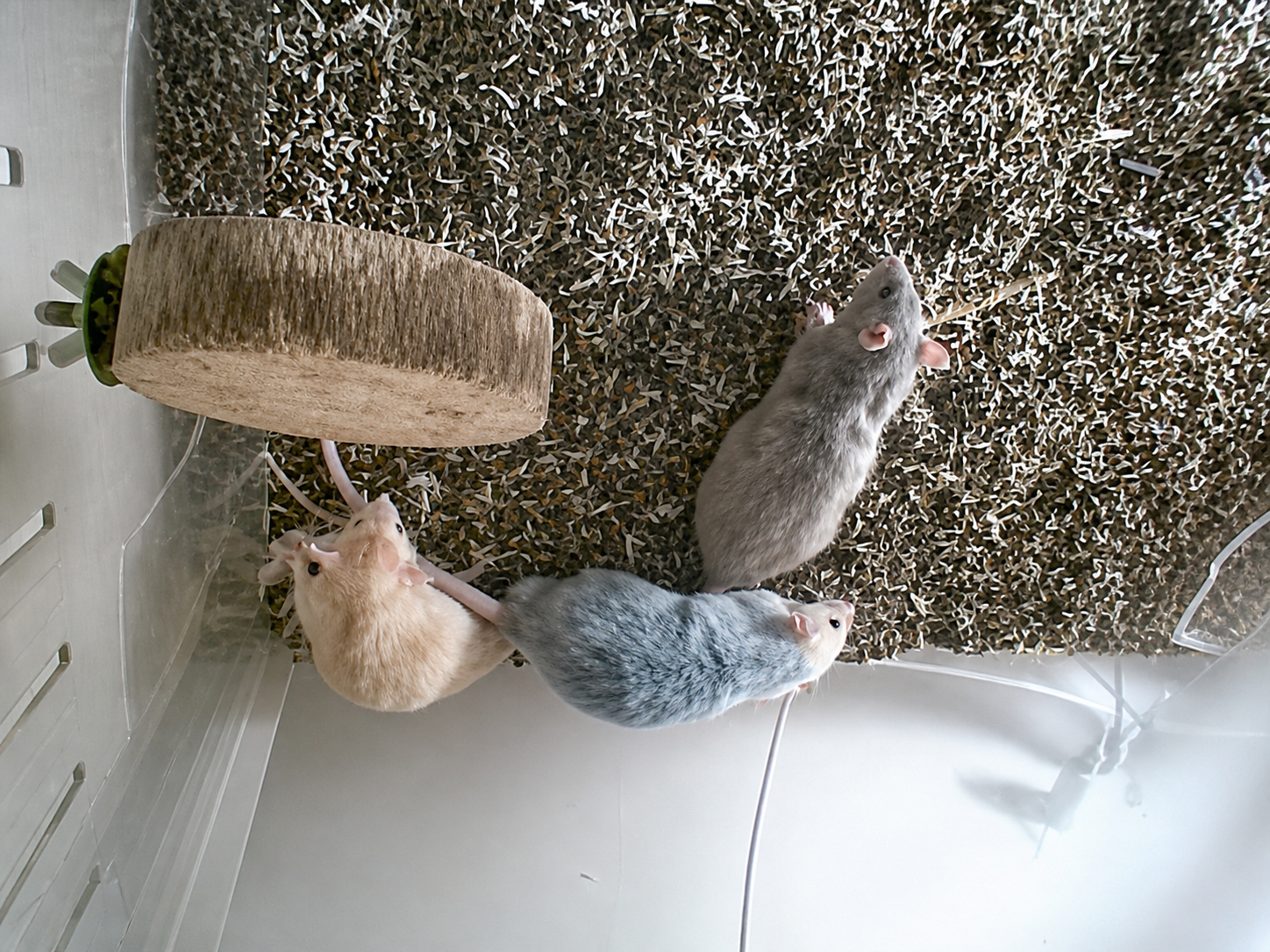
The original image from the mouse cage was not ideal. The overall scene was unclear, the edges were blurred, and many details were difficult to recognize. I could still see that there were three mice in the cage, and I could roughly identify their positions. However, it was difficult to observe finer details such as their fur texture, body posture, eyes, ears, and tails.
For casual observation, this might be acceptable. But for real monitoring, this level of image quality is not enough.
The main limitations were clear:
Poor performance in low light
A normal camera depends heavily on visible light. When the room becomes dark, the image quality drops quickly.Motion blur
Mice move quickly. In low-light conditions, the camera may use a slower shutter speed, which makes moving animals appear blurry.Lighting can disturb natural behavior
Turning on the room light makes the image clearer, but it may also change the mice’s natural behavior.Image restoration has limits
A restored image may look better, but it cannot fully recover details that were never captured by the camera in the first place.
3. Image Restoration: Better Visual Quality, but Not a Complete Solution
After enhancing the original image into a higher-definition version, the result looked much better. The cage structure became clearer, the bedding texture was easier to see, and the outlines of the mice became sharper.
This showed that image restoration can be useful.
It can help improve:
- visual clarity;
- object boundaries;
- overall image quality;
- presentation and documentation.
However, this step also revealed a deeper problem. Image restoration only improves what has already been captured. If the camera does not receive enough light at night, then the missing information cannot be truly recovered.
For a monitoring system, I do not only need one good-looking image. I need stable, continuous, and reliable video recording. Therefore, image restoration is more like a repair method. It improves the result, but it does not solve the root problem.
4. Infrared Night Vision: The Real Requirement
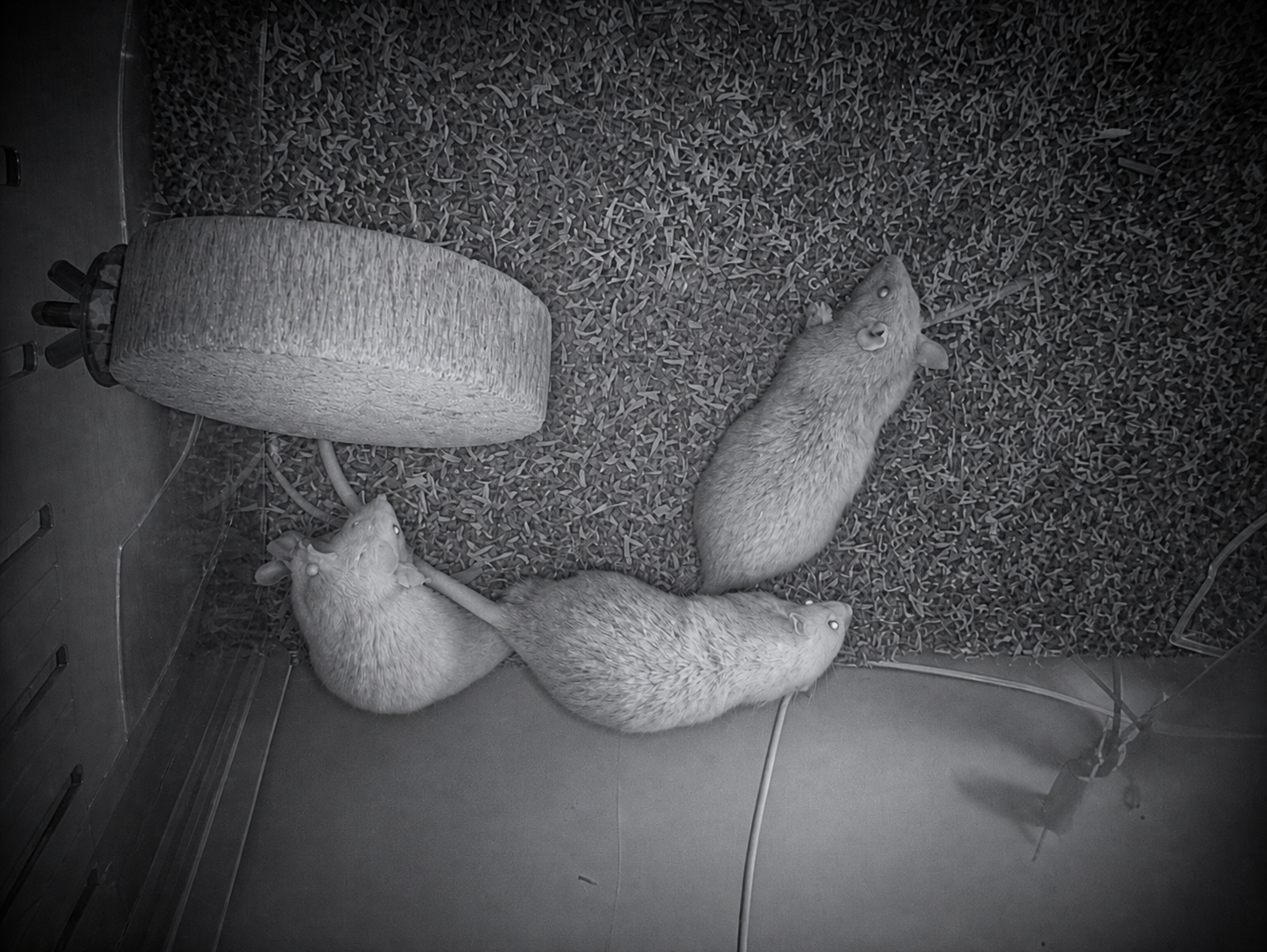
When the image was converted into an infrared night-vision style, the monitoring purpose became much clearer.
Infrared night vision does not focus on rich or beautiful colors. Instead, it focuses on visibility and stability in darkness. This is exactly what mouse cage monitoring needs.
An infrared camera is useful because it allows observation without visible light. The mice can remain in a relatively natural environment, while the camera can still record their movements.
The advantages are obvious:
4.1 Observation in Darkness
The camera can work even when the room light is turned off. This makes it possible to observe nighttime behavior without using strong visible light.
4.2 More Stable Monitoring
Compared with a normal low-light image, an infrared night-vision image is usually more stable and readable.
4.3 Suitable for Long-Term Recording
Mouse cage monitoring is not about taking one single photo. It requires continuous observation. If the camera fails every night because of poor lighting, then the monitoring system is not truly useful.
4.4 Better for Future Automatic Analysis
If I want to build an automatic behavior analysis system in the future, stable video input will be very important. For example, the system might detect whether a mouse is eating, moving, resting, or staying still for too long. Infrared footage may lose natural color, but it can still preserve important movement and shape information.
5. My Thought Process
My thinking changed step by step.
At first, I only wanted to “see” the mice. As long as the camera showed something inside the cage, I thought it was enough.
Later, I realized that simply seeing them was not enough. I needed to see them clearly. If the image was too blurry, I could not judge their real condition.
Then, after trying image restoration, I understood that clarity was important, but clarity alone was still not the final goal.
The real goal is to observe clearly without disturbing the mice.
If I turn on the light just to make the camera work better, the mice may behave differently. In that case, the monitoring result is no longer fully natural. A monitoring system should record behavior, not change it.
So my final conclusion became clear: I do not just need a normal camera. I need an infrared camera that can support nighttime, long-term, and low-disturbance observation.
6. Discussion
Mouse cage monitoring may look like a small project, but it actually involves several important problems.
The first problem is image quality. A normal camera works in good lighting, but performs poorly in darkness.
The second problem is behavioral authenticity. If visible light is used at night, the mice may change their natural behavior.
The third problem is system reliability. A monitoring system that only works during the day cannot fully capture the important nighttime activity of mice.
Therefore, the value of an infrared camera is not simply that it makes the image look special. Its real value is that it solves the key conflict in mouse cage monitoring: I need to see clearly, but I also need to avoid disturbing the animals.
This is why infrared night vision is more important than simple image enhancement.
7. Conclusion
Through this process, I gradually understood what my mouse cage monitoring system really needs.
A normal camera is enough for basic daytime observation. Image restoration can improve a single photo. But if the goal is long-term observation of natural mouse behavior, especially at night, then an infrared camera is the better and more necessary solution.
It changes the system from “occasionally visible” to “continuously observable.” It changes the image from “visually improved” to “informationally useful.” Most importantly, it allows observation with less disturbance.
That is why we need an infrared camera.
Or, in the title of this project:
That Is Why We Need an IR Camera
Note
This article is based on my personal mouse cage monitoring experience, image restoration process, and infrared night-vision comparison.
Comments (0)
Be the first to leave a thought.